
The Latest Chinese Strategy: Go Big or Go Home
- Adam Bernard
- Jan 21, 2025
- 3 min read
Updated: Jan 26, 2025
I remember seeing the first Chinese vehicles at what was then known as the North American International Auto Show in Detroit back in 2007. They looked bland (or, occasionally, weird), smelled funny, and were accompanied by press materials that showed a poor grasp of English. Suffice it to say that a lot has happened since then; we've seen better (and more original) designs, more sophisticated engineering, higher-quality materials, and state-of-the-art technology. What happens next? Onward and upward, it seems...
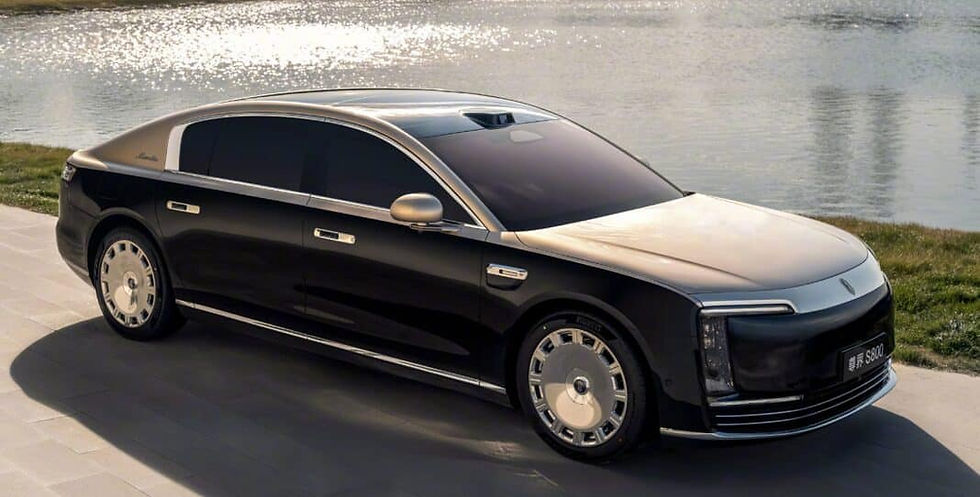
Five years ago, the idea of paying six figures for a vehicle designed, engineered, and built in China by a Chinese brand might have sounded absurd. But as Chinese vehicles have become more competitive and boosted their local market share, Chinese OEMs are pushing upmarket--way upmarket. The latest is Maextro, a joint venture between Anhui Jianghuai Automobile Group (JAC) and tech giant Huawei. Starting with the S800 flagship, the Maextro portfolio will roll out of a brand new plant featuring about 1,500 robots to aid in jointing, painting, and gluing; JAC has indicated targeted volumes of about 35,000 for the $140,000-200,000 S800, with more vehicles to follow to fill the plant's expected capacity of 200,000 units annually. Around the same size as the Rolls-Royce Ghost, the S800 will offer your choice of EV (up to 860+ hp on the tri-motor variant) or EREV power.
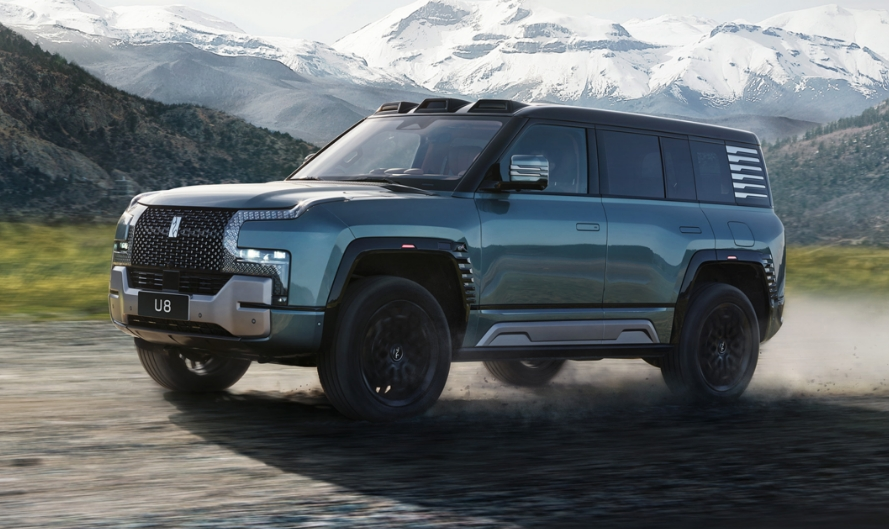
But Maextro is not alone. BYD launched their Yangwang brand last year, initially with two vehicles:
The $150,000 U8 fullsize SUV features napa leather, open-grain Sapele wood veneer, twin 23.6" displays, a 22-speaker Dolby Atmos capable audio system. Underneath is a four-wheel-steering setup and a four-motor, 1200 hp EREV powertrain, and it can not only wade through 1 meter of water, but it can float.

Not to be outdone, Great Wall (BMW's partner in the new electric Minis, among other things) has announced plans for its own ultra-luxury brand, to be chaired by the company's chairman and run by its Chief Technology Officer. Curiously, it appears the new brand may use the company's existing 4.0L turbo V8, suggesting an EREV setup rather than a pure EV—but perhaps we will learn more at this year's Shanghai Auto Show in April.
WHY IT MATTERS
Why are Chinese automakers heading into the stratosphere with their products? To quote John Dillinger, "That's where the money is". VMR expects last year's $162B luxury car market in China to continue growing through the rest of the decade, noting, "The key driver of the segment’s expansion is China’s ongoing rise in ultra-high-net-worth people (UHNWI) and high-net-worth individuals." And, with more Chinese brands looking to export, and with Rolls-Royce, Lamborghini, and Ferrari claiming record or near-record sales lately, there are people out there with money to spend. If you’re in a Bentley, Gelandewagen, or Ferrari frame of mind with money to burn, the Chinese have something you might like.
WHO SHOULD CARE
There are a few things these Chinese ultra-luxury brands lack compared to the legacy players. The first, of course, is heritage, and there are buyers out there for whom that matters. The second is any sort of bespoke capability; Rolls-Royce just announced a $376M investment to focus largely on bespoke operations, and both Ferrari and Bentley have pointed to their bespoke operations as profit generators. The third--and it's more of an unknown rather than a missing ingredient--is the customer experience. Can these new brands deliver the sort of exclusive ownership experience that Bentley and Rolls customers expect? Or will these brands focus on buyers less concerned about the experience and more concerned with the product itself? Time will tell, but it will make for an interesting landscape…


Comments