
Is Toyota Getting Serious About EVs?
About two and half years ago, Toyota US sales chief Bob Carter said he wanted Toyota to be the "Macy's of powertrains". For those of you too young to remember, Macy's used to be an expansive brick-and-mortar department store chain that had something for everyone--and so Toyota theoretically wanted to be able to offer gas, diesel, hybrid, plug-in hybrid, electric, and hydrogen to all their buyers. Many people saw that as an excuse to avoid investing significantly EVs. To make matters worse, Toyota was accused of spreading anti-EV propaganda in Japan, and claiming a looming lithium shortage would curtail some automakers' EV plans. And if you looked at the first generation of modern Toyota EVs--the Toyota bZ4X, Lexus RZ, and electric versions of the Toyota C-HR and Lexus UX--you would have seen a rather unimpressive portfolio of products that suggested Toyota's efforts trgeted compliance, not leadership.
But Toyota hasn't been operating in a vacuum. They heard from customers and journalists, and have even acknowledged a "crisis"--and have begun to respond in a big way, with new technologies, new products, and new partnerships that seem to be sending the signal that, finally, Toyota intends to build truly competitive EVs for global markets.
THE PLAN
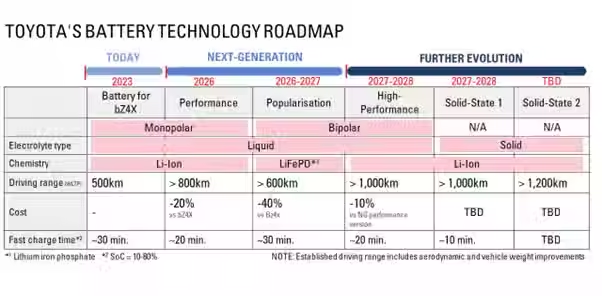
Two years ago, Toyota unveiled a roadmap starting in 2026 to roll out a new generation of batteries. These include:
Performance NCM (nickel cobalt manganese) batteries with 60% more range, 20% lower cost, and 1/3 faster DC charge time than the current bZ4X
Value-oriented LFP (lithium iron phosphate) batteries with 20% more range than the bZ4X but 40% cheaper
High-performance NCM batteries with double the range of the bZ4X
Solid-state batteries (starting potentially as early as 2027) with an eventual target range of about 740mi on the European cycle (or about 500mi EPA)
Later that year, Toyota unveiled a wave of EV concepts at the Japan Mobility Show, including a compact pickup truck, a sports car, a midsize SUV badged Land Cruiser, an MPV, and a Lexus sedan and SUV. The last two are the most important, as Toyota indicated these would be the lead vehicles for Toyota's next-generation EV architecture, targeting a 2026 launch (which has apparently slipped to 2027). This new architecture would feature Toyota's new internally developed Arene OS, aero enhancements to target a Cd of 0.20, steer-by-wire capability, gigacasting, and a "self-driving assembly line"--in other words, a quantum leap over the ICE-derived hardware underpinning the Lexus RZ and Toyota bZ4X.
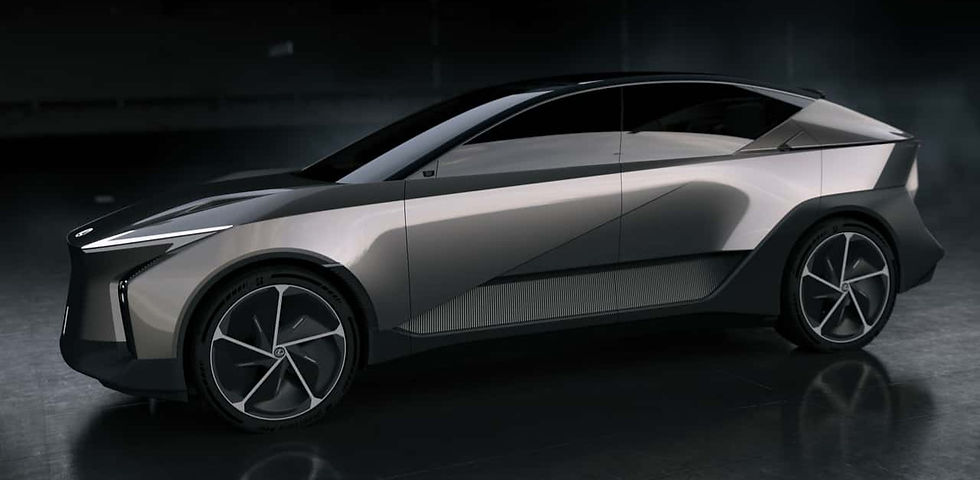

But these are concepts, right? And we all know of plenty of examples where an automaker has shown a concept but then falters on the follow-through. But, while 2027--the theoretical target for the production version of the LF-ZL--is still two years off, the past couple of months have seen a wave of actual production EVs--and technology upgrades--that appear to be pretty competitive.
First up is the bZ3X, which was revealed at the Beijing Motor Show in 2024 but went on sale earlier this year. Remember the comment about partnerships earlier? This is one of those--specifically, with GAC (Guangzhou Automobile Group). The bZ3X is based on GAC's Aion AEP platform, related to GAC's own Aion V, but styled and sold by Toyota (and only in China). The specs are modest: 200hp, 24min for a 30-80% charge, and 323mi on the Chinese cycle (~240mi EPA). But there's a big 14.7" screen, a Qualcomm Snapdragon chip, and available lidar, all for $15-21,000--which is why it reportedly proved to be so popular it crashed Toyota's servers after it went on sale.

More recently, they held a big press event in Europe to unveil new technologies and new products. Remember the discussion about upgraded batteries? We didn't see those here (it's still a bit early, after all) but Toyota did announce significant upgrades to the batteries for both the bZ4X and RZ:
New base and uplevel batteries, with the bZ4X maximum range jumping about 10%, and the RZ maximum range jumping about 20%
Upgraded e-axles with silicon carbide semiconductors, with 330hp on the AWD bZ4X, over 50% more than the current model, and up to 402hp on the AWD RZ, a 30% bump
New battery preconditioning to improve DC fast charge speeds (although the charge rate remains at 150kW)--and a new available 22kW home charger
Updated steer-by-wire on the RZ
On the product side, there were two production launches and one new concept. Toyota's new B-segment SUV EV is the Urban Cruiser, a badge-engineered variant of the Suzuki eVitara. Just a bit bigger than the Yaris Cross, but with quite a bit more interior space, it features either FWD or AWD, a sliding rear seat, up to 181hp, and up to 249mi on the WLTP cycle (~215mi EPA), twin digital displays. Nothing earth-shattering here, but a new entry for Toyota in this segment that seems at least competitive with the other B-SUVs in the market like the Ford Puma Gen-E and Citroen e-C3 Aircross.

One size up is the C-HR+, the production version of the bZ Compact concept shown at the Los Angeles Auto Show in 2022. Now, there are two potential points of confusion here:
This is a completely different vehicle from the internal combustion C-HR, which is still being built in Turkey for some markets (but not the US). Toyota is apparently scrapping the bZ ("beyond zero") moniker outside of China, preferring to rely on established names for its new EVs--and that's why the Urban Cruiser isn't called the bZ2X, I suspect.
This is also a completely different vehicle from the visually similar bZ3C, which was unveiled last year. That vehicle is a result of a collaboration with EV powerhouse BYD and is built by Toyota's joint venture with FAW (First Auto Works) and will only be sold in China.
Frankly, the C-HR+ seems like a much more competitive vehicle than even the upgraded bZ4X, with which it shares powertrain components. It has better looks and more range (up to 373mi in Europe, or ~320mi EPA) and hits Europe later this year; a North American launch is rumored for 2026, although that may be dependent on tariffs.

Finally, with Renault's new Mobilize Duo and Stellantis' trio of electric quadricycles (Citroen Ami, Fiat Topolino, and Opel Rocks-E) all going after the micromobility market, Toyota is apparently looking for a piece of the action. The FT-ME concept is around the size of the original Smart ForTwo, featuring jet-helmet-inspired styling, a solar roof to add miles, and hand-operated controls with wheelchairs to offer accessibility for all drivers. There arent any detailed technical specs and it's not confirmed for production, but it appears ready to go...

But, in the spirit of Steve Jobs' legendary "one more thing" Toyota teased not one, not two, but three additional EVs due in Europe by the end of 2026. The middle one is pretty obvious--an electric HiLux midsize pickup, which Toyota has already been talking about for a launch in Thailand this year. The vehicle on the left appears to be yet another compact SUV (which seems like it would step on the toes of both the C-HR+ and bZ4X), while the vehicle on the right appears to be a larger SUV, perhaps with a third row to compete with the new Kia EV9.

WHO SHOULD WORRY?
Remember that Toyota (and Lexus) have pretty strong brands, a global sales and manufacturing footprint, plenty of experience with electrification, a new CEO, and a profitable internal combustion business (which admittedly took a hit in Q2 of FY24, according to the latest results). And, true to the spirit of Macy's, they continue to add more plug-in hybrids to their portfolio on top of new EVs to maximize consumer choice. Frankly, just about every automaker should be concerned at this point; although Toyota has made missteps in the past, they have proven to be quite resilient.
Are there any flaws or challenges to the strategy? A few thoughts...
Just like Macy's, maintaining a diverse portfolio of powertrain technologies requires financial and technical resources.
It appears the middle of Toyota's SUV portfolio is getting rather crowded; are there too many overlapping entries?
Where are the cars? Toyota still maintains several actual internal combustion cars in their portfolio, but where's the EV counterpart to the Corolla and/or Camry? There is a bZ4 sedan in China--but that's only for China, and it's another JV development with BYD.
On the "wait for it" side, there is still the battery roadmap to be executed as well as some interesting EV sports concepts that may or may not see the light of day.
So, there's still more to come. But it should make for an interesting couple of years to see how this all develops...


Comments