
highlights from the japan mobility show
Updated: Nov 5, 2025
Check out the video here: https://youtu.be/Oy23erag3MI

This year’s Japan Mobility Show—the event formerly known as the Tokyo motor show—was once again a showcase for Japanese automakers, with one notable exception. And while the 2023 event featured a strong focus on EVs, the number of this year’s concepts didn’t even specify what was under the hood. Here’s a look at some of the notable production and concept debuts at the show…

BYD RACCO: THE CHINESE COME KNOCKING...
Chinese powerhouse BYD brought the brand’s first kei car to Tokyo, and visually, it looks like just about every other kei car out there, fitted with BYD’s Blade LFP battery with a range of up to 112 miles and DC fast charging up to 100 kilowatts.
WHY IT MATTERS: With over a million and a half kei cars sold in Japan last year (accounting for about 40% of new vehicle sales), it’s a key segment for BYD to break into. This is also the company’s first vehicle designed exclusively for markets outside of China.
THE BOTTOM LINE: It doesn’t break any new ground, but it’s certainly a competitive entry, and will help get young buyers into showrooms as they slowly expand their presence in Japan

HONDA SUPER ONE: THE EV HOT HATCH
After showing a camouflage Super EV concept at the Goodwood Festival of Speed in July, we now see the production version badged as Super One for Asia and Super N for the UK. It looks like a beefed-up electric version of Honda’s kei car, and that’s pretty much what it is, designed to appeal to performance enthusiasts. When it launches in Japan, the rest of Asia, and the UK next year, it will include a new boost mode and a simulated 7-speed transmission with virtual engine sounds.
WHY IT MATTERS: We’ve seen high-performance kei cars in the past, but this is the first electric one that we’ve seen, and it could help Honda stand out from the crowd. The transmission and engine sound tweaks are not unlike what Hyundai has done with their EVs, and we’ll see how successful it is here.
THE BOTTOM LINE: Without any technical specs or performance numbers, it’s too early to say how cool this vehicle is, but visually, it does pack a bit of a punch.

DAIHATSU K-OPEN: THE MINI-MIATA
With the second-generation Daihatsu Copen scheduled to end production next summer, they rolled out this potential third-generation concept and tweaked the formula by changing the configuration from front drive to longitudinal rear drive. It’s still a kei car, which means it’s about 10 inches shorter than a Fiat 500 E, which created some significant challenges for packaging. The interior is quite minimalist and includes a physical handbrake and lacks both a touch screen and a head-up display.
WHY IT MATTERS: Kei car sports cars are fairly rare, so this gives Daihatsu a chance to stand out from the rest of the mini car crowd. And the ability to create a launch additional rear drive vehicle that small demonstrates some degree of technical sophistication.
THE BOTTOM LINE: Although not confirmed for production, we are likely to see this hit the road in the next year or two, but it’s likely that only Japanese and perhaps European customers will get a chance to enjoy it.

MAZDA VISION X COMPACT: THE NEW 2?
This aggressively proportioned 5-door hatchback could preview the next-generation Mazda 2, with a long wheelbase, short overhangs, and an excellent wheel-to-body relationship. Mazda has said they want to build it, but haven’t specified what might be under the hood. They say it’s “designed to deepen the bond between people and cars through the fusion of a human sensory digital model and empathetic AI.” In other words, it’s not only your car, but also your buddy. This interior is also fairly minimal, without a touch screen and only a singular circular multipurpose gauge and an adjacent smartphone dock.
WHY IT MATTERS: Mazda remains largely independent and hopes to leverage its design capabilities to help separate itself from the other Japanese brands. The big question is where electrification fits into their future, as the vision seems to be changing fairly regularly.
THE BOTTOM LINE: If Mazda wants to go after the Mini Cooper with a small, stylish fun to fun-to-drive hatchback, this could be the way forward.

TOYOTA COROLLA: REINVENTING A BEST-SELLER
Remember when the Toyota Prius used to be ugly? And then, after five generations, someone said, “I guess we could make it attractive?” Well, it seems the same thing happened in the development of this Corolla concept. The Corolla was never ugly, but it was always a bit vanilla. Toyota says its goal here was to reinvent the best-selling car of all time, and this is certainly a more dramatic-looking Corolla than we’ve ever seen. They haven’t committed to production yet, but they seem quite interested in making this the next Corolla, and the new platform is said to be capable of supporting electric, gas, hybrid, plug-in hybrid, and hydrogen fuel cell powertrains. Inside, you won’t find many physical controls, but you will find a satellite touch panel just off the steering wheel and a center console replaced by a floating panel that houses the gear selector and phone chargers.
WHY IT MATTERS: This is Toyota’s bread and butter product around the world, and they can’t afford to get it wrong. The new multi-energy platform is a new development for Toyota, whichits up to now has largely been separating their EV and ICE hardware. If they can pull this off, it suggests the possibility of additional multi-energy platforms for other product segments.
THE BOTTOM LINE: If Toyota can build this stylish and efficient sedan with their legendary quality, reliability, and durability, they could have a winner.
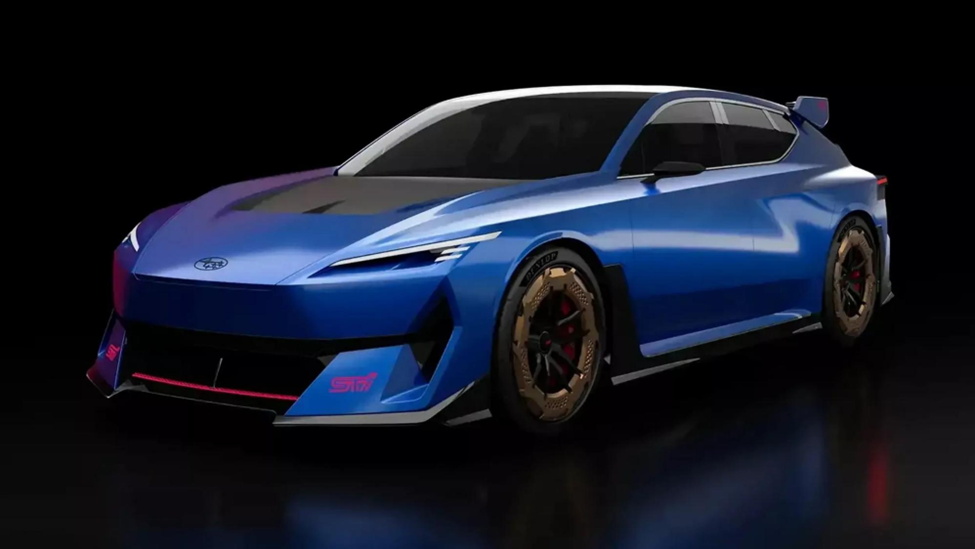
SUBARU E-STI: ELECTRIFIED POCKET ROCKET
Subaru says the required gasoline particulate filters in Europe are literally choking their engines, meaning that European customers are missing out on the most powerful Subarus. Subaru is looking to “bring back the sportiness in Subaru,” and they believe electrification is the route to get there. This exterior model suggests a possible future electric performance sedan in traditional Subaru blue and gold livery. It would theoretically use a twin motor all-wheel drive layout, but we don’t have any additional technical specs beyond that.
WHY IT MATTERS: Up to now, Subaru has been relying on Toyota for hardware. Does this concept suggest that they are on their way to developing their own EV platform worthy of the STI badge?
THE BOTTOM LINE: There’s not enough substance here to draw any good conclusions, but it is clear that Subaru is trying to figure out what the future of their brand looks like from an electrification standpoint.

MAZDA VISION X COUPE: POTENT AND GREEN
This surprisingly large 4-door fastback coupe, even bigger than the new Mazda 6e mid-size sedan, is designed to evolve Mazda’s design language and showcase a new high-performance electrified powertrain. Under the hood is a 503-horsepower, turbocharged, two-rotor plug-in hybrid with an EV range of about 100 miles. In addition, the car is designed to reduce CO2 emissions by combining carbon-neutral fuel derived from microalgae with Mazda’s proprietary CO2 capture technology. The interior is stylish and straightforward, with a trio of retro-style round gauges with electronic displays as well as central and passenger side screens.
WHY IT MATTERS: Mazda’s rotary engine is small and powerful but not very fuel efficient on its own, and they’ve been experimenting with a variety of hybrid configurations to help bring the engine back into production. We’ll see if this winds up being the final solution.
THE BOTTOM LINE: Stylish as any Mazda we’ve seen so far, with a suitably intriguing high-performance powertrain under the hood.
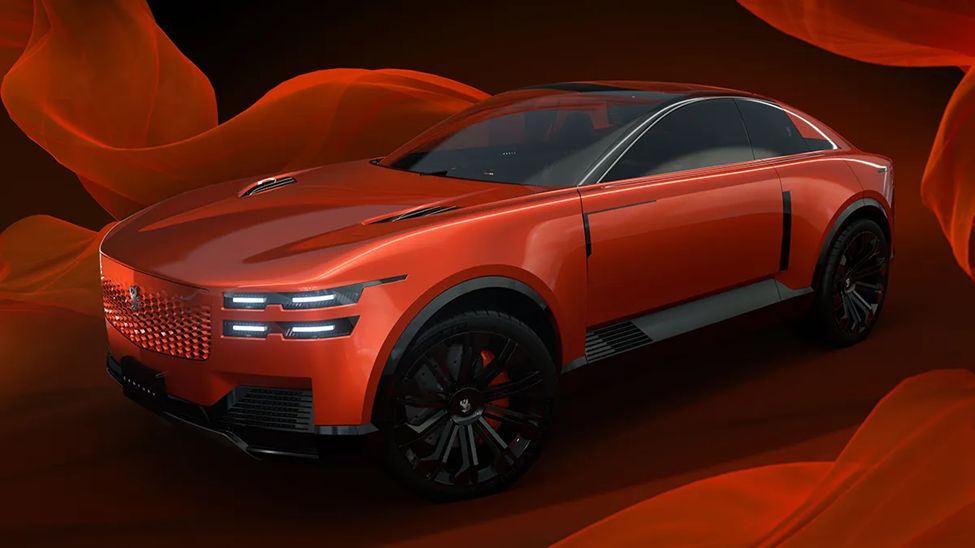
CENTURY COUPE: GUNNING FOR BENTLEY AND ROLLS
The original Toyota Century was launched in 1967 as a largely hand-built, old-school luxury sedan targeting Japanese diplomats. This Century coupe marks Toyota’s chairman’s efforts to take the brand global and to take on Bentley and Rolls-Royce. Not unlike the Bentley EXP 15 concept from earlier this year, this is a 3-passenger coupe with a blunt front end and a fastback profile. The interior layout is similar to Bentley’s, with a wooden central console, a single driver seat up front, and two passenger seats in the back.
WHY IT MATTERS: Bentley and Ferrari have made no secret of the fact that the bespoke business is a profitable one, and taking the Century brand global could turn out to be a money maker for Toyota if they execute it properly. This move is also designed to let the Lexus brand explore new opportunities in the less exclusive upper premium market. However, to make this happen, they will likely need to boost production and build a suitable ecosystem leveraging the existing Lexus dealer network, which is a nontrivial effort.
THE BOTTOM LINE: It’s certainly a dramatic concept, but there’s not much new here, and Century will have to define a visual language to help set them apart from Bentley and Rolls Royce that perhaps leverages their Japanese heritage. Of course, because the chairman wants this to happen, it likely will, and it’s just a matter of time.

HONDA 0 SERIES ALPHA: NEW COMPACT EV
Although this looks almost identical to the mid-size 0 series SUV shown at CES 2025 in Las Vegas, this is a smaller compact entry that will launch in 2020 to target Japan and India. It will share a lot of the hardware and software with the other 0 Series vehicles that we’ve seen so far but there aren’t any additional technical specifications available.
WHY IT MATTERS: Honda has been relatively slow to embrace EVs, and so this new 0 series platform is very significant for the future of their portfolio. With a slim battery pack, compact electric axle and new Asimo operating system, it should be able to help source a portfolio of competitive EV’s. The decision to make this vehicle nearly identical to its larger brother is a bit confusing, as is the decision to not send this vehicle to Europe or North America.
THE BOTTOM LINE: If you like the larger model, you’ll love this as well, but it’s hard to offer a true opinion without additional technical specifications.

MITSUBISHI ELEVANCE: THE SMART OFFROADER
This off-road-oriented, three-row mid-size SUV features an AI co-driver that acts as a personal travel assistant, offering destination suggestions based on driver habits and lifestyle, and drive mode recommendations based on the terrain. More significant and innovative is the plug-in hybrid system, which features four individually controllable electric motors. Mitsubishi also references the large capacity battery that enables towing, and the fact that the gas engine only kicks in on longer trips. In fact, if you didn’t know better, you’d swear this was an EREV and not a PHEV—but Mitsubishi refers to it as the latter. The engine itself is compatible with carbon-neutral fuel, and the front motors are actually mounted in the front wheels. Interior features three pillar-to-pillaof displays with the 4th display in the steering wheel hub, and a swiveling front bench seat to create a lounge space.
WHY IT MATTERS: Between rebadging Renault products and leveraging Nissan platforms, Mitsubishi is in danger of losing its identity, so this is an opportunity for them to remind consumers of what they do best. Plug-in hybrids have always been a strength of theirs, and this configuration seems unusually innovative and might be under consideration for production in the future.
THE BOTTOM LINE: Stylish and capable, but unlikely to go into production as shown

LEXUS LS COUPE: TARGETING BMW AND PORSCHE
After showing the LF-ZL concept in 2023, this follow-up is an SUV coupe that could take on the BMW X6 and Porsche Cayenne coupe. There are no details on the powertrain , but it does feature a high-speed drone that can deploy from the rear deck to follow the car around and document a journey. Inside is an asymmetrical interior with a black driver’s seat and a retractable passenger screen, and overlapping driver displays with the steering yoke.
WHY IT MATTERS: The idea of an SUV coupe is one small gap in Lexus’ current portfolio, and this vehicle may also point the direction to Lexus’ future design language, inside and out.
THE BOTTOM LINE: Does Lexus really need an SUV coupe? It couldn’t hurt.

NISSAN ELGRAND: THE PREMIUM HYBRID MINIVAN
As a model that likely won’t be sold outside of Japan, the 4th generation of Nissan’s premium minivan isn’t incredibly relevant outside that country. The “timeless Japanese futurism” design is intriguing, especially as applied to what is essentially a box on wheels; Nissan notes the grill texture was inspired by Japanese kumiko patterns. What is more significant is the third-generation e-Power series hybrid system, with a new purpose-built engine and a five-in-one electric powertrain; it’s also the first Nissan to use their updated e4ORCE electric all-wheel drive.
WHY IT MATTERS: Nissan’s series hybrid powertrain is somewhat unique in the industry, and if they ever decide to add a plug to it, that would give them an EREV powertrain, which is among the trendier bits of technology these days. This hardware is expected to propagate across the Nissan portfolio and will also be used in Infiniti products.
THE BOTTOM LINE: Some nice aesthetic touches--and even real wood and leather--but the real story is the new e-Power hardware.

LEXUS LS: SIX-WHEELED LUXURY CHARIOT
With the LS sedan exiting production, the term now stands for luxury space instead of luxury sedan, and Lexus has decided to explore opportunities for a next-generation luxury minivan. Lexus already sells the LM in select markets, including China, which is based on the Toyota Alphard, but this is clearly a step further. While there are a few technical details available, Lexus notes the four small rear wheels are designed to minimize intrusion into the cabin, and the interior features a similar dual screen layout to the Lexus LS coupe concept.
WHY IT MATTERS: Chinese buyers love luxury minivans, which is why there are over half a dozen entries in that segment at the moment, and even Volvo is playing in that space with the help of parent Geely. The new Mercedes V-class platform is expected to yield a VLS luxury van variant as well, and that vehicle is expected to come to the US market. It seems like Lexus is in the luxury minivan market for the long haul, so we’ll see if anything from this concept impacts the next generation level.
THE BOTTOM LINE: It’s definitely the sort of over-the-top concept that one expects to see in this venue, but it does have some potential future production applications.
Comments