
Deep Dive: Nissan's "Full Speed Ahead" Plan
- Adam Bernard
- Apr 8, 2025
- 5 min read

The past year has been pretty rough for Nissan. Just over a year ago, things looked a bit brighter when they signed a memorandum of understanding with Honda to discuss collaborating on software platforms, EV components, and other products. The companies agreed to collaborate in specific areas (including software-defined vehicles, batteries, e-axles, and cross-sharing of products) in August and opened the door to additional discussions.
In December, they signed a new memorandum of understanding to pursue a full merger to be executed by 2026, which would include Nissan's existing alliance partner, Mitsubishi. And, well, let's just say it didn't go as smoothly as expected. Honda's market cap was significantly higher, and they were also doing better financially; Nissan said their operating margin for the first nine months of FY24 was only 0.7%, and forecast an operating loss of about $550M for all of FY24. Talks quickly fell apart when it became apparent Nissan was a junior partner, and shortly after that, Nissan's CEO was removed and replaced by the head of Nissan global planning, hailed by the media as a "car guy".
All of that set the stage for the recent reveal of an array of shadowed products to be rolled out globally between now and 2028. Under the hood of some of these new vehicles is Nissan's 3rd generation ePower. Launched in 2016, ePower is a series hybrid, whereby a small gasoline engine and lithium-ion battery power an electric motor that drives the wheels--creating a more EV-like experience than a traditional parallel hybrid like the Toyota Prius. Although Nissan didn't specifically mention it, you could add a plug to this system to create an extended range EV, not unlike the old Chevy Volt or upcoming Ram 1500 Ramcharger.
As far as the new cars and trucks, let's take a look at what we saw...
NORTH AMERICA
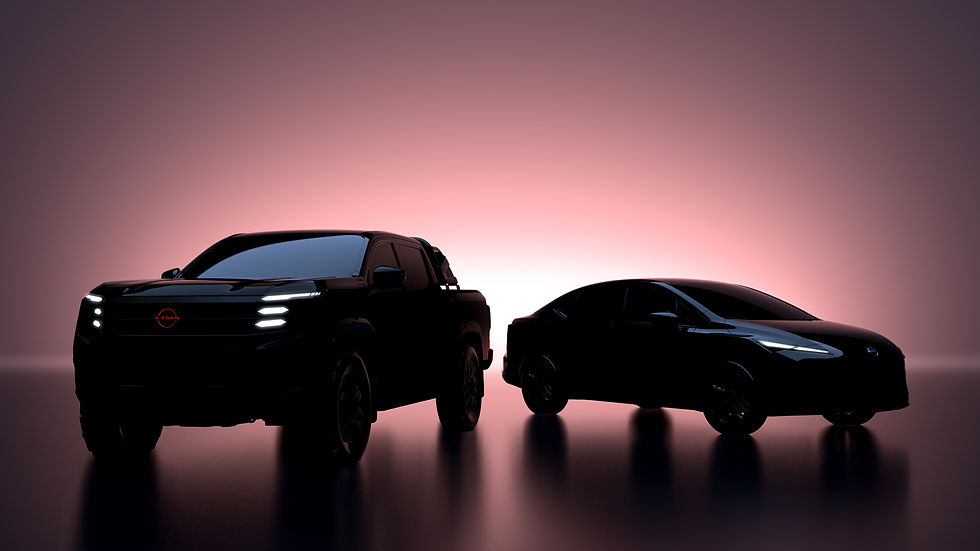
The photo at the top includes quite a bit of interesting stuff...
The next Leaf, due later this year, is repositioned as a small SUV, replacing the 16-year-old small hatchback and sharing its platform with the larger and more expensive Ariya. It will offer 19" wheels, a panoramic roof, a likely EPA range of up to 320 miles, and a standard NACS charging port.
The next Sentra, also due later this year, indicates that, unlike some brands, Nissan is not getting out of the sedan business. It will be joined by an updated Pathfinder
On the right are two Rogues: a PHEV version of the current model (using hardware from its Mitsubishi Outlander sibling), and the next-generation model due in 2027, which is supposed to offer gasoline, PHEV, and ePower options
Way in the back is potentially the most interesting product: an "adventure-focused SUV" EV likely due in early 2028. You may recall Nissan announced plans in late 2022 to launch two US-built EV sedans later this year. Those programs were initially delayed, and now appear to be outright cancelled. Meanwhile, the new EV SUV builds on the popularity of vehicles like the Ford Bronco Sport and Hyundai's new XRT-branded SUVs, and might even revive the Xterra name. It will use a new platform that Nissan says might source a compact EV pickup by 2030.

Meanwhile, the long-neglected Infiniti brand (which is about to lose the QX50 and QX55 SUVs, after already dropping the Q50 sedan) gets a few new products...
The QX65, on the left, is a new two-row, coupe variant of the QX60, and is due in 2026
The QX60, on the right, gets a facelift later this year
Way in the back is the new Infiniti EV, a compact luxury SUV due around 2028 and built in the US alongside Nissan's "Xterra" EV

Europe gets the aforementioned Leaf, alongside the new Juke EV (on the left) and a new Micra EV (on the right). The Micra is based on the new Renault 5 E-Tech, sharing its platform, powertrain, and manufacturing site, but with a cute retro-ish design inspired by the bug-eyed 3rd-generation Micra. Nissan also mentioned the next-generation Qashqai compact SUV, now with ePower; you might recall it used to be sold in North America as the Rogue Sport--but no longer. Shortly after this reveal, Nissan confirmed they will also be getting a product based on the €20,000 Renault Twingo EV launching in 2026, which would slot below the Micra.
Latin America gets a next-generation Frontier/Navara in 2026--but don't confuse this with the North American Frontier, which is based on a ~20-year-old platform. They also get a new Versa sedan, as well as the aforementioned updated QX60 and new QX65 from Infiniti.

India gets two new Nissan entries, but they're not as new as you think. Nissan gets variants of the existing Renault Triber small MPV and just-launched Dacia Duster compact SUV. The plan also includes Renault buying out Nissan's 51% share of Renault Nissan Automotive India Private Limited. So, Nissan gets some cash and a couple of new products to boot.
HOW ARE THINGS SHAPING UP?
Well, there are some signs of movement in the right direction here...
Updates to ePower are coming just as the market is starting to embrace hybrids and plug-in hybrids as EV demand slows--so that's good timing.
The changes to the Leaf may be overdue, but are welcome, and give Nissan a competitor to the slick Kia EV3 and upcoming updated Chevy Bolt.
Leveraging Renault for new affordable EVs in Europe seems like a wise move.
India is a pretty sizable (and growing) car market, so boosting Nissan's presence there (and reducing their financial commitment) also sounds like a good idea.
A new SUV/pickup-focused EV platform will arrive right around the time the current CMF-EV architecture is due for replacement--and the idea of a compact EV pickup (not unlike what Ford is planning for 2027) would be a good fit for the Nissan portfolio.
However, there are some open issues and concerns...
Is Nissan working on plug-in hybrids? That seems to be a key gap in their powertrain portfolio, at least in the short term.
The Infiniti updates may be too little, too late. The QX65 is a niche product, and the remaining BMW X3-sized gap in the portfolio leaves Infiniti without a compact luxury SUV for about three years. Even then, all they get is a single EV in 2028.
EV demand may be slowing, but it's not declining (ask BMW and Hyundai), and it looks like Nissan's EV portfolio will be extremely light in the US for the next few years.
THE BOTTOM LINE: There are some interesting products here, but some strategic gaps to be addressed as well. Everything we see here was conceived under the previous CEO, so it remains to be seen how Nissan's new leader adapts--and how Honda will figure into Nissan's future.
PS: Oh, and yes--tariffs could wind up throwing a giant wrench into these plans, so take all this with a grain of salt while the dust settles.


Comments