
Quick Take: 2025 Los Angeles Auto Show

There has been plenty written lately about the future of auto shows, and what they mean—or don’t mean—to automakers and consumers in today’s frantic, online, instant-gratification-fueled world. I’m pleased to report that, while several automakers skipped this year’s Los Angeles Auto Show, it was an altogether entertaining and educational experience. If I had to complain about one thing, it would be the singular item outside the show’s control: the rain.
THE SHOW ITSELF
It was a pleasant surprise to see a reasonably crowded show floor full of both vehicles and exhibits (not just “cars on carpets”)—and a significant number of attendees on press day as well. In addition, there were a number of ancillary exhibits, both in the hall (including an impressive collection of classic Japanese performance cars) and outside in the plaza. And although there were only a few actual press conferences on press day, the rest of the day was filled with a variety of speakers and discussion panels, including executives from Lucid and Scout, and a look at the state of autonomous technology.
THE REALLY NEW CARS
There were two significant debuts actually at the show (technically, one occurred the night before the press day), and both were reflective of the US market’s increasing interest in offroading—or, at least, the perception that one is capable of offroading.

The Jeep Recon—first shown as a concept over three years ago—finally made its production debut prior to sales beginning early next year. It appears unchanged from the previous concept and looks exactly like you would expect an EV counterpart to the Wrangler to look. Sharing the STLA Large architecture with the Jeep Wagoneer S, the Recon boasts impressive performance from its 650-horsepower dual motor drivetrain (0-60 mph in a blistering 3.6 seconds) but, as you might expect, the vehicle mass and blocky profile keep the range down to 230 miles (for the premium $65,000 Moab model that launches first), or 250 miles for an upcoming more affordable model. The removable doors, quarter glass, and tailgate glass—no tools required—provide a Wrangler-esque open-air feel, aided by the standard dual-pane sunroof or optional sliding canvas roof. It’s also got plenty of off-road-capable hardware, including an electronic locking differential, large diameter half shafts, 33” tires, and a 9.1” ground clearance. The only other thing I would have liked to see was a 'complete' Recon, with doors and glass in place. Overall, it’s a pretty slick execution, but the 400V architecture (which restricts charging speeds compared to 800V vehicles at the same price point) and low range (for which I would have happily traded off the blistering 0-60 time) might prove to be barriers to success.

Meanwhile, Hyundai Motor Company’s California studio offered up the Crater—yes, I know, a vehicle named after a giant hole in the ground. This compact SUV was reportedly built off an Ioniq 5 platform for convenience, which makes sense given the lack of any powertrain info in the press kit—although the parametric pixel lighting tends to be an EV-specific feature. Not quite as blocky as the Recon but just as butch, it features chiseled surfaces and wheels reportedly inspired by a “hexagonal asteroid impacting a sheetmetal landscape.” There’s a roof platform to mount auxiliary lighting and additional accessories, and the outside rear view cameras are also removable cameras. The interior is where the fun begins, though, with a tubular, backlit, perforated dashboard and a full-width head-up display (similar to BMW’s Panoramic iDrive). There are also front and rear locking differentials, and traction and braking management should you head off-road. Hyundai didn’t confirm, but strongly hinted at, production plans, and they could leverage their rallying heritage to convince consumers they’ve got the capability to challenge Jeep and Bronco in this segment.
A FEW SIDE TRIPS
In addition to seeing several vehicles in person that have been introduced over the past couple of months and that I’ve already talked about—including the Nissan Leaf, Kia Telluride, Chevy Bolt, and even the Tensor robocar—there were a couple of other items of note that caught my eye.
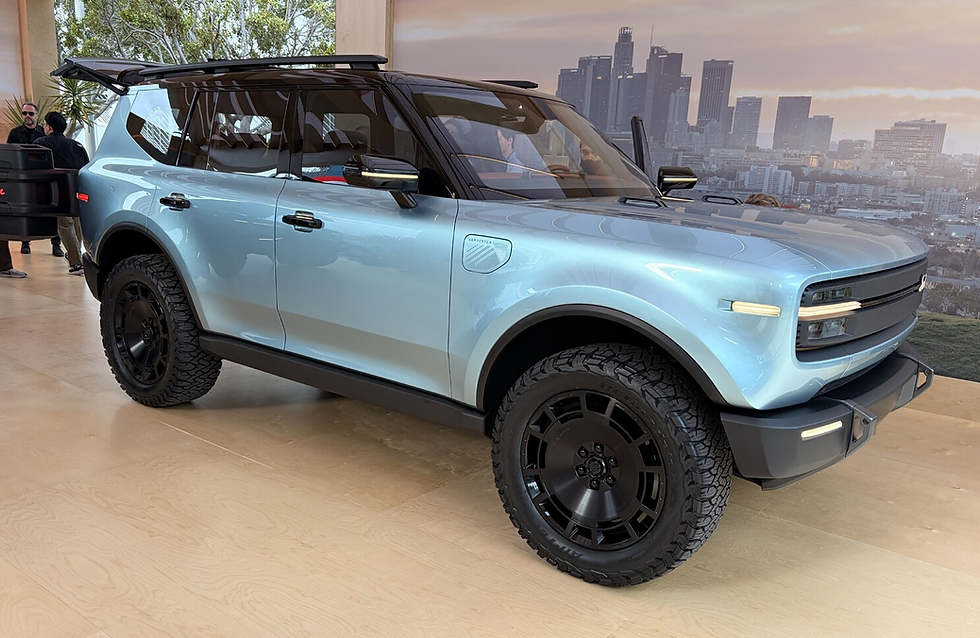
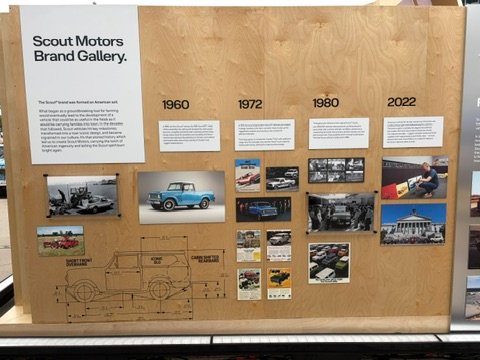
The first was the auto show debut for Scout Motors Inc. , the “startup” launched in 2022 within VW Group. Originally targeting a 2026 debut, the vehicles unveiled last year are now due in 2027 out of a brand new plant in South Carolina on a brand new body-on-frame platform, in both EV and EREV variants. Scout’s outdoor exhibit included a giant covered shed—very handy given the rainy weather—that included the Terra pickup and Traveler SUV. They also included some accessories, a display on the history of the Scout brand, and a collage showcasing the various materials used inside the Scouts. I had been impressed when I watched the video debut last year, and the products in person did not disappoint. Big and bold, they exhibit enough of the Scout character to be recognizable but not overtly retro, with some very nicely executed interiors with an array of precision-engineered physical controls. We are still about two years away from launch, and so I know it will be a challenge to keep the momentum going, but I wish them well. I have heard the decision to add EREV was rather last-minute, but, with about 80% of the reservations indicating a preference for the EREV, it seems to be a smart move.
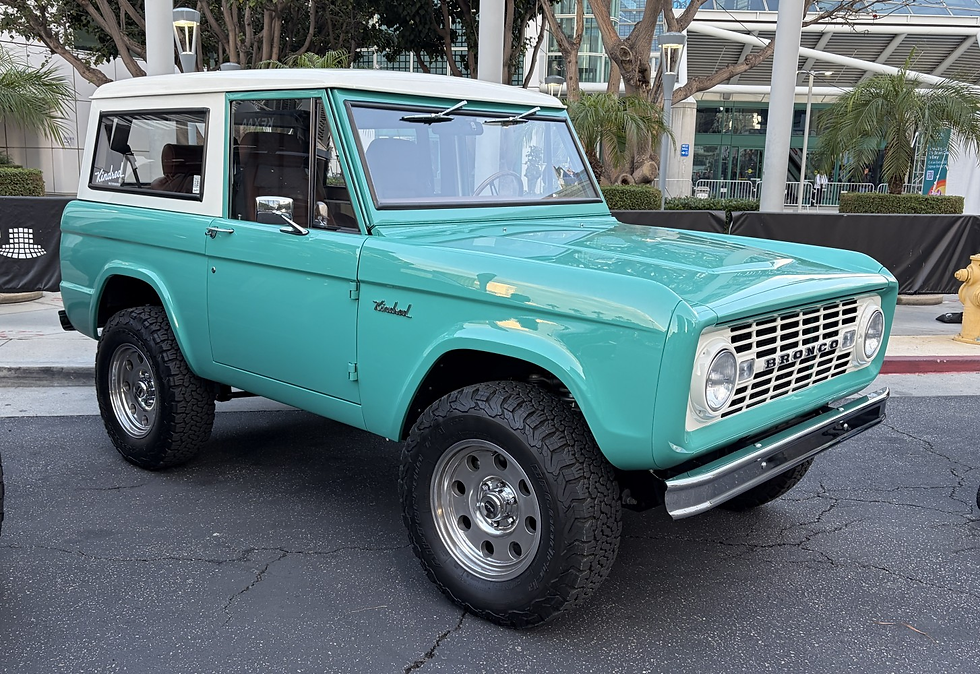
I also met Rob Howard, CEO of Kindred Motorworks. At first glance, this looks like one of several other companies doing EV conversions of classic vehicles—in this case, a 1st generation Bronco displayed at the show. It turns out the story is more nuanced than that. Operating on a peninsula in Napa Valley out of a resurrected naval shipyard, the 110-person operation launched in 2019 and now builds one or two vehicles per week. Each model they make is the result of over 10,000 hours of prototyping, testing, and designing—so, not a one-off, but a very low-volume production line with no robots and about 1,300 hours of labor per vehicle. Their lineup includes classic Broncos (gas and electric) with an electric 1st generation Microbus just added. More importantly, because they have developed a standardized portfolio of parts, they can now work with dealers who can not only sell but also service these very high-end ($200,000+) toys.
THE BOTTOM LINE
Although I didn’t get a chance to attend this year’s IAA in Munich, it sounds like there were more automakers participating, and more news coming out of the show--which bodes well for other events. I know we’ll never get to the “good days” of auto shows, but for those of us watching the entire industry, it’s an unparalleled opportunity to get a big-picture look at everything that’s going on, and so as far as I'm concerned, the more, the merrier. Here’s hoping the people running the current portfolio of global auto shows continue to improve the experience…
#jeep #recon #hyundai #crater #conceptcar #automotive #autoperspectives #porsche #cayenne #genesis #magmahalan #supercars #nissan #navara #tata #sierra #ev #electricvehicle
Comments