
News Roundup: Sept 28, 2026
Check out the video: https://youtu.be/4uitOP7wELI
Bentley’s First EV
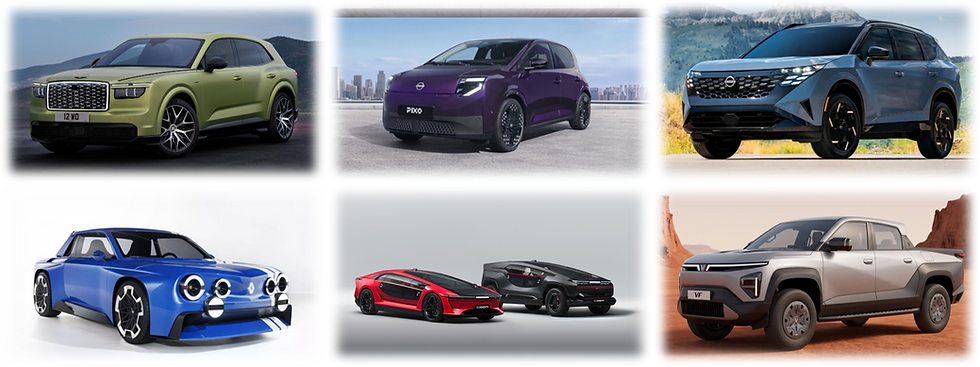
Bentley’s first EV, the Torcal, blends the marque’s traditional luxury character with the performance and technology of Porsche’s 800-volt PPE platform. Slightly smaller and less expensive than the Bentayga, the $218,000 SUV pairs a 108 kWh battery with dual motors producing up to 876 hp and an estimated 375-mile WLTP range, while rear-wheel steering and fully active dampers aim to preserve Bentley’s signature “magic carpet” ride. Its EXP15-inspired exterior features slim four-element headlights, an illuminated diamond grille, muscular rear arches, and a wheels-at-the-corners stance. Inside, a wing-shaped dashboard, curved portrait display, physical knurled controls, premium trim choices, Merino wool, adaptive seat-temperature sensors, animated ambient lighting, facial-recognition profiles, and bespoke orchestral sound design give the Torcal a distinctly Bentley interpretation of an electric luxury vehicle.
WHY IT MATTERS: The Torcal splits the difference between the very traditional Rolls-Royce Spectre and Ferrari’s Luce, blending heritage with new technology on a state-of-the-art platform.
THE BOTTOM LINE: Stylish and innovative, and setting the stage for the next generation of Bentleys.
Renault Goes Retro
Renault’s electric Renault 8 Gordini concept reimagines the compact, rear-engined performance sedan that debuted in the 1960s as an exuberant two-seat EV. Developed in-house, it combines dramatically flared wheelarches, six round LED headlights, staggered 19- and 20-inch wheels, a prominent rear wing, and a race-car-style removable front end with a 270 hp rear-mounted motor. The cabin carries the retro theme through a full-width brushed-aluminum shelf for round digital instruments, aluminum controls, Alcantara-and-corduroy upholstery, and door stitching inspired by a racetrack.
WHY IT MATTERS: Although production appears unlikely, the concept demonstrates how effectively Renault can turn its heritage into desirable modern designs.
THE BOTTOM LINE: Here’s hoping that Renault offers diecast and/or radio-control models for Renault enthusiasts to enjoy.
Pixo Returns
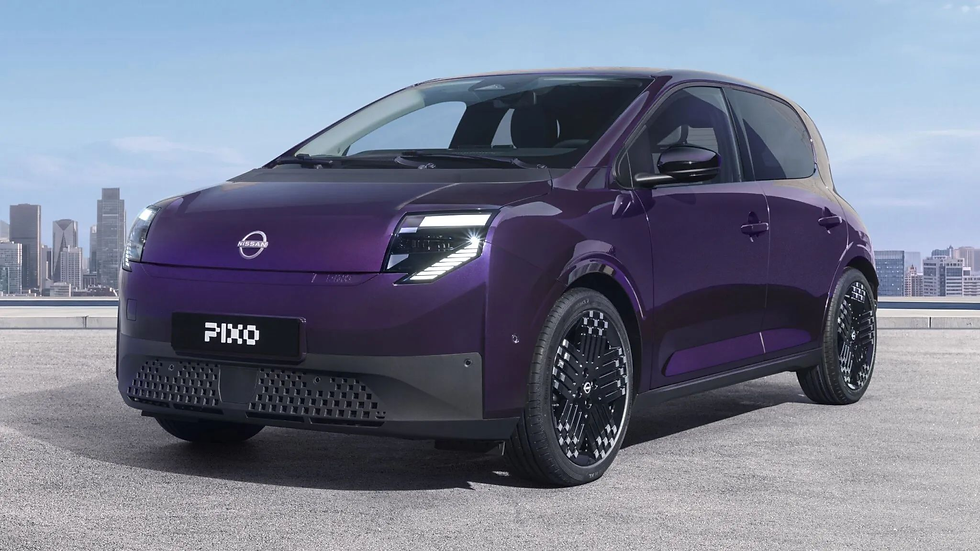
The new Nissan Pixo is the third member of Renault-Nissan’s affordable electric-car family, sharing much of its structure and technology with the Renault Twingo E-Tech while adopting a distinct Nissan identity. Its greenhouse and doors carry over from the Twingo, but a more upright nose, unique rear bodywork, and pixel-inspired lighting and wheels differentiate it from both the Renault and the more extensively restyled Dacia Spring. The cabin similarly uses Renault screens and controls with unique dashboard surfacing and colorful accents. Its powertrain matches the Twingo’s, although DC fast charging falls from 80 kW to 50 kW.
WHY IT MATTERS: With a growing field of small European and Chinese EVs on the way—including the VW ID.Up and Citroen 2CV—the Pixo gives Nissan dealers a timely and competitive entry-level electric hatchback.
THE BOTTOM LINE: Not quite as cute as the Twingo, but definitely a viable option for those shopping for an affordable EV.
Saudi Arabia’s First EV
Saudi Arabian startup Ceer has unveiled the Exobot sedan and SUV, two futuristic flagship EVs created through a partnership between the Saudi Public Investment Fund and Foxconn, with drive components supplied by Rimac and Hyundai Transys. Their dramatic styling includes gullwing “Shahin Wing” doors with electronically dimmable lower glass and 32 signature light bars referencing Saudi Arabia’s 1932 unification. A bespoke 800-volt platform, 112 kWh battery, and 1,111 hp tri-motor powertrain deliver 0–60 mph times of 2.1 seconds for the sedan and 2.4 seconds for the SUV, while a 10–80% charge takes about 30 minutes; estimated EPA-equivalent range is roughly 280 and 230 miles, respectively. Inside are a steer-by-wire yoke, cantilevered console, full-width display, advanced driver-assistance claims, and “Halo” cooling that can rapidly reduce extreme cabin temperatures. The Exobots are due next year, with five additional EV and hybrid models planned for 2028–2030 and a new factory targeting 240,000 vehicles annually, though pricing and export plans remain unannounced.
WHY IT MATTERS: As ironic as it may seem for an oil-rich country to invest in EVs, that’s where Saudi Arabia sees the future going, and this startup is intended to take the lead.
THE BOTTOM LINE: Incredibly bold styling and high performance may not be enough to offset the less-than-competitive range, but it will be interesting to see what the rest of the portfolio looks like.
Nissan’s New Rogue
The redesigned Nissan Rogue e-Power arrives on an updated platform with fresh styling, more cabin space, and a 225 hp series-hybrid powertrain combining a turbocharged 1.5-liter three-cylinder engine, dual electric motors, and all-wheel drive. Its honeycomb grille, slim LED headlights, segmented running lights, Mount Fuji-inspired C-pillar, and rear doors that open nearly 90 degrees emphasize both style and usability. Starting at about $37,000 and rated at 38 mpg combined, the Rogue also brings EV-like one-pedal driving and a Smooth Stop feature designed to reduce head movement under braking; the initial $43,000 SR launch model includes the Technology Package. Inside, it claims more room than the hybrid-only RAV4, offers a standard 12.3-inch touchscreen or twin 14.3-inch displays on the flagship, retains physical climate controls, and adds built-in Google and Gemini, available Zero Gravity seats, 64-color ambient lighting, ProPILOT hands-off traffic-jam support, and an invisible-hood camera view.
WHY IT MATTERS: The compact SUV segment is highly competitive, and Nissan has been trailing others in offering a hybrid—and e-Power puts a unique (and customer-relevant) twist on hybrid technology.
THE BOTTOM LINE: Aside from e-Power, there’s not much new here, but it appears the Rogue has all it needs to at least be viewed as a competitive offering.
Vinfast Goes Wild
The production VinFast VF Wild retains the adventurous look of the 2024 concept while adopting an extended-range electric powertrain built around a 1.5-liter gasoline engine, a 160 kW motor, and a 46 kWh LFP battery. It offers about 250 km of NEDC electric range—roughly 115 EPA-equivalent miles—along with 10–70% fast charging in 32 minutes and vehicle-to-load capability. The midsize pickup has a five-foot bed and a 1,650-pound payload, putting its utility in the range of the Ford Ranger and Toyota Hilux. Inside, it features a flat floor, a 10-inch touchscreen, and a reclining rear seat, but no separate driver instrument cluster. Priced at about $34,000 in Vietnam, the VF Wild currently has no announced plans for other markets as VinFast shifts its growth focus toward Asia following a difficult U.S. launch.
WHY IT MATTERS: There is a significant opportunities for midsize trucks around the world, and this is a big opportunity for Vinfast to broaden their market coverage—and also beat the Chinese at their own game with a capable EREV.
THE BOTTOM LINE: Handsome and competent, the VF Wild brings EREV technology to a fairly competitive segment, but will have to prove themselves among a crowd of established brands.

Comments